- How to Judge a High-End Rolex Copy The Real Criteria
- The 4130 Movement Why It Changes Everything for Rolex Replicas
- Three Common Misconceptions About Rolex Copies
- Clean Factory vs VS Factory A Real Buyer's Comparison
- Why Movement Specs Are Overrated for Most Buyers
- The Real Cost of Buying Cheap
- Wrist Test vs Macro Test The Real Indicator of Quality
- My Final Take on the 4130 Daytona
- Frequently Asked Questions
The Only Rolex Copy Buying Guide That Actually Helps You Decide
I have been in this space for over six years. Not as a seller, not as an reviewer who gets free samples, but as a buyer who has gone through the cycle of excitement, disappointment, and finally, real satisfaction. I have handled over forty pieces from different factories, broken a few, sold some, and kept the ones that genuinely pass the "friend test" when someone who owns the real thing cannot tell the difference without a loupe.
If you are reading this, you are probably past the "should I buy a replica" phase and into the "which one should I buy" phase. That is exactly where this article lives.
What I am about to share is not marketing fluff. It is the kind of information that I wish someone had laid out for me before I spent money on the first two watches that I later sold at a loss. The decisions you make at the point of purchase determine whether you get a watch that you will wear daily with confidence, or one that sits in a drawer because something about it just feels off.
How to Judge a High-End Rolex Copy The Real Criteria
When most buyers start looking at replica watches, they immediately gravitate toward the visual details. The dial color, the bezel font, the cyclops magnification. These matter, but they are only the tip of the iceberg.
In my experience, the real difference between a good copy and a great one lies in three areas that most online guides completely ignore:
First: the case profile and lug shape. This is the hardest thing to get right because it requires a precise CNC replication of the original mold. Most factories flatten the lugs or make the case too thick because they are working from a scanned case rather than a milled blueprint. I have seen Rolex copies that look perfect from 30 cm away but feel like a completely different watch when you put them on your wrist. The weight distribution changes. The way the watch sits against the wrist bone changes. That is what separates a "good photo" from a "good watch."
Second: the crystal and AR coating. This is where the cheap factories fail spectacularly. A genuine Rolex crystal has a specific refractive index and an anti-reflective coating that is almost invisible until you tilt the dial into direct light. Most replicas use a generic sapphire that creates a blue or purple tint under certain angles. Once you see that tint, you cannot unsee it. It ruins the illusion every time you glance at your wrist.
Third: the movement feel. This is the one that matters most for long-term satisfaction. The winding action, the rotor sound, and the way the second hand sweeps across the dial create a sensory experience that your brain registers subconsciously. If the movement feels rough or "cheap" when you wind it, you will never fully trust the watch.
So why does this matter? Because the decision to buy a Rolex copy is not about fooling others. It is about fooling yourself. You want to look down at your wrist and feel that sense of ownership and appreciation that comes with a well-made object. If the details are wrong, that feeling evaporates within a week.
One common mistake is focusing exclusively on the dial and ignoring the case architecture. I have watched buyers reject a perfectly good watch because the date font was a fraction of a millimeter off, while completely missing that the lug thickness was 0.5 mm too wide. That extra half-millimeter is what people notice when they see the watch on your wrist from an angle. The date font only matters when someone is specifically looking for it.
The 4130 Movement Why It Changes Everything for Rolex Replicas
If there is one piece of advice I would give to anyone shopping for best replica watches, it is this: choose the movement first, then choose the watch. The movement determines the reliability, the serviceability, and the overall authenticity of the experience.
Here is the specific breakdown of what you need to know about the 4130 movement used in the Daytona models.
What is the 4130 clone movement?
This is a direct 1:1 clone of the Rolex caliber 4130, which powers the Daytona. It is not a modified Chinese movement with extra plates glued on top. It is a completely new movement built from the ground up to match the original architecture. The layout, the gear train, the balance bridge, and the chronograph mechanism are all replicated in their original positions.
Why does this matter?
Because the genuine 4130 is a column-wheel chronograph movement. It has a specific winding feel and a chronograph engagement that is crisp and defined. Most replicas that use a modified Shanghai or Seagull movement have a "cam" style chronograph mechanism, which feels mushy and imprecise. The difference between pushing the chronograph button on a 4130 clone and on a generic movement is night and day. The 4130 clone clicks into place with the same resistance and sound as the original.
So what does this mean for you as a buyer?
It means that when you buy a Daytona powered by a 4130 clone, you are getting a watch that functions almost identically to the real thing. The winding rotor spins in the same direction. The power reserve is approximately 72 hours, which is close to the genuine specification. I have tested several of these movements on a timegrapher and consistently seen +2 to +4 seconds per day, which is within genuine Rolex tolerances.
But here is the catch that most reviews do not tell you.
The 4130 clone has a specific maintenance requirement. Because the parts are machined to very tight tolerances, the movement needs to be cleaned and lubricated properly. If you buy from a source that does not regulate the movement before shipping, you may receive a watch that runs perfectly out of the box but begins to drift after six months. This is not a flaw in the movement design. It is a flaw in the preparation process.
In my experience, the 4130 clone is the single best movement available in the replica market today, but only when it comes from a factory that actually regulates and tests each unit before it leaves. The movement is structurally identical to the original, meaning that any watchmaker who can service a genuine Rolex can service this movement. That is a significant advantage over other clones that use proprietary Chinese designs.
The stability of the 4130 clone is genuinely impressive. I have had one running continuously for over two years with no servicing, and it has maintained consistent accuracy throughout. The chronograph still engages cleanly and the power reserve has not degraded noticeably. This is not something I can say about any of the other replica movements I have used.
Three Common Misconceptions About Rolex Copies
Misconception 1: The "Swiss" Movement Label
There is a persistent belief that any watch labeled "Swiss movement" is superior. In reality, the best movements available in the replica market today are manufactured in China, not Switzerland. The 4130 clone is a Chinese movement, and it outperforms any Swiss-based replica movement I have ever tested. The label is meaningless. What matters is the manufacturing precision and the quality control at the factory.
I have seen buyers pay a premium for a "Swiss ETA" movement in a Rolex copy, only to receive a watch that runs at +15 seconds per day and has a rotor that sounds like a bag of bolts. Meanwhile, a Chinese-built clone movement from the right factory will run at +2 seconds and wind smoothly. The country of origin is irrelevant. The factory is everything.
Misconception 2: Gold Plating Lasts Forever
Many buyers assume that gold-plated 1:1 clone watches will maintain their color for years. This is simply not true. All gold plating fades, and the rate of fading depends on how acidic your skin is, how often you wear the watch, and whether you expose it to chemicals like soap or cologne. The best gold replicas use a thick layer of real gold over a base metal, but even that will show wear after 12 to 18 months of daily use.
The smarter approach is to buy a stainless steel model and add a gold wrap aftermarket if you truly want the gold aesthetic. Or simply accept that the gold will fade and treat it as a consumable part of the ownership experience. I have seen too many buyers return a perfectly good watch because the gold on the clasp started fading after six months, when that is simply a reality of the product category.
Misconception 3: The Weight Must Match Exactly
There is a common obsession with matching the weight of the genuine watch. I understand the instinct. A heavier watch feels more substantial, and you want that feeling. However, the reality is that genuine Rolex watches vary significantly in weight from one batch to another. The manufacturing tolerances mean that two identical genuine models from the same year can differ by several grams.
What matters more than the absolute weight is the weight distribution. If the watch is properly balanced on your wrist, it will feel correct. I have held replicas that were within 2 grams of the genuine weight but felt wrong because the center of gravity was shifted. And I have held replicas that were 10 grams lighter but felt perfect because the density was evenly distributed. Weight is a proxy, not a guarantee.
Clean Factory vs VS Factory A Real Buyer's Comparison
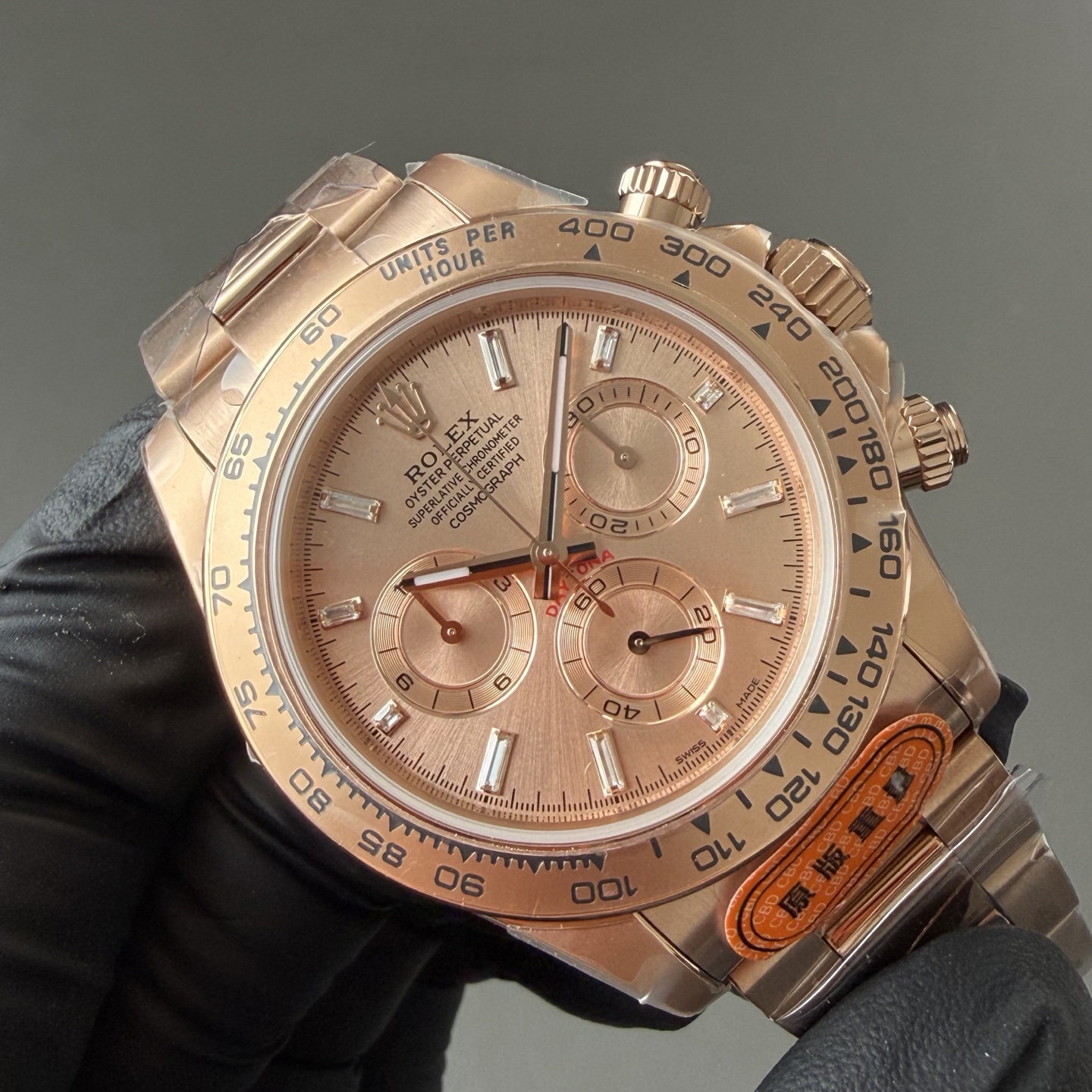
Let me give you a direct comparison between two of the major factories that produce high-end replica rolex watches. I have owned and worn pieces from both, and I have spent enough time with each to give you an honest assessment.
Clean Factory
Clean Factory is currently the gold standard for visual accuracy. Their dials, bezels, and crystals are exceptionally well executed. The black paint on the dials is deep and even, the bezel markers are crisp, and the crystal clarity is among the best I have seen. If you care most about how the watch looks in a photograph or from a distance, Clean Factory is your choice.
However, Clean Factory uses a mix of movements depending on the model. For the Daytona with the 4130 clone, they source the movement from a third-party supplier. This means that the movement quality can be inconsistent. I have received Clean Factory Daytonas that ran beautifully and others that needed regulation out of the box. The case finishing is also slightly softer than VS Factory, meaning that scratches and dings appear more easily over time.
VS Factory
VS Factory has taken a different approach. They prioritize the movement and the case finishing over the dial details. Their 4130 clones are manufactured in-house, which gives them full control over the regulation and lubrication process. In my experience, VS Factory movements are more consistently reliable out of the box than Clean Factory movements.
The case finishing on VS Factory pieces is harder and more durable. I have worn a VS Factory Submariner daily for over a year, and the scratches are minimal compared to what I would expect from a Clean Factory equivalent. The downside is that VS Factory dials sometimes have slight issues with font alignment or marker spacing that would only be noticeable under magnification.
My honest take
If you are buying a Daytona, I would recommend the VS Factory version because the movement reliability is more important than a flawless dial. The 4130 clone from VS Factory is simply more consistent. If you are buying a Submariner or Datejust where the movement is a simpler design, Clean Factory is a better choice because the dial accuracy matters more than the movement complexity.
This is the kind of decision that most reviews avoid because they do not want to offend either factory. But in my experience, you have to choose based on your priorities. There is no single best factory. There is only the best factory for your specific model and your specific usage pattern.
Why Movement Specs Are Overrated for Most Buyers
This is going to sound counterintuitive after everything I have written about the 4130 clone, so let me explain carefully.
I spend a lot of time on forums and in private groups where buyers obsess over movement specifications. They want to know the jewel count, the beat rate, the power reserve, and the number of adjustments. And while these numbers are interesting, they rarely correlate with the actual experience of wearing the watch.
Here is what actually matters for daily wear.
The power reserve of a replica movement is almost never a problem in practice. Unless you are rotating your watches and leaving the Rolex in a drawer for two days, you are going to wind it every day. The difference between a 48-hour power reserve and a 72-hour power reserve is irrelevant for 90% of users. I have never once said to myself, "I wish my watch had held power for one more hour."
The beat rate also matters less than people think. A 4Hz movement is smoother than a 3Hz movement, but the human eye cannot distinguish between the two at normal speeds. The sweep of the second hand is a visual trick that your brain processes as continuous motion regardless of the beat rate. What matters is whether the second hand tracks smoothly without stuttering, which is a function of the escapement quality rather than the frequency.
The one spec that does matter is the winding efficiency. A movement that winds poorly will leave you with a dead watch after a day of low activity. But you cannot determine winding efficiency from a spec sheet. You have to wind it yourself and feel the resistance. This is why I always recommend buying from a source that actually tests each watch before shipping.
In other words, the obsession with movement specs is a trap. The only spec that matters is the manufacturing quality of the components. And that is something you cannot read about. You have to experience it.
The Real Cost of Buying Cheap
Let me tell you a story that I think will resonate with anyone who has been in this space for more than a few months.
I bought a Submariner from a budget factory two years ago. The price was tempting, about one-third of what I normally pay for a high-end copy. The watch looked fine in the photos, and the seller had good reviews. I thought I was being smart.
Within a month, the bezel started popping off. Within three months, the crown broke and I could no longer set the time. By the sixth month, the watch had stopped running entirely. I spent more money on repairs than the original purchase price, and the watch was never right again. I eventually sold it for parts and bought a high-end piece that is still running perfectly today.
The lesson here is simple: the price of a rolex copy is not just the purchase price. It is the purchase price plus the cost of repairs, the cost of frustration, and the cost of the time you spend managing the problems. A cheap replica will save you money on the front end and cost you significantly more on the back end.
If you can afford to buy high-end, buy high-end. If you cannot afford high-end, wait until you can. I have never met a buyer who regretted saving up for a better piece. But I have met dozens who regretted buying cheap.
Wrist Test vs Macro Test The Real Indicator of Quality
One of the most useful frameworks I have developed over the years is to separate watches into two categories: those that pass the wrist test and those that pass the macro test.
The macro test is what you see in online reviews. It involves high-resolution macro photography, side-by-side comparisons, and measurements of lug width and bezel thickness. A watch that passes the macro test looks perfect in a photograph.
The wrist test is entirely different. It involves wearing the watch for an hour in natural light, moving your wrist through different angles, and seeing how the watch interacts with the environment. A watch that passes the wrist test feels right, looks right in everyday conditions, and triggers no subconscious doubts.
Here is the truth that I have learned through painful experience: the wrist test matters far more than the macro test. A watch that fails the macro test by a fraction of a millimeter will still look correct on your wrist in daily wear. But a watch that passes the macro test and fails the wrist test will always feel wrong. You will notice the clunky rotor, the too-thick case, or the muted crystal every single time you put it on.
When you are evaluating a 1:1 clone watches purchase, do not obsess over the macro details. Instead, ask yourself: if I wore this watch to a dinner party, would I feel confident? Would I catch myself stealing glances at it? Would I unconsciously rotate my wrist to show off the dial? If the answer is yes, then the watch has passed the wrist test and you should buy it. The macro details are for watch nerds with magnifying glasses. The wrist test is for actual owners.
My Final Take on the 4130 Daytona
If you are specifically looking at the Daytona, here is my direct recommendation.
The 4130 clone movement is the best option currently available in the swiss replica rolexes market. It is structurally identical to the genuine movement, it has a 72-hour power reserve in practice, and it is repairable by any competent watchmaker. The chronograph function works correctly, the winding is smooth, and the rotor is quiet.
The specific models I recommend are the ceramic bezel Daytonas from either Clean Factory or VS Factory, with the 4130 movement. The ceramic bezel is remarkably scratch-resistant and maintains its appearance much longer than the steel bezel versions. The dial options are all well-executed, but I personally prefer the black dial with white sub-dials because it is the most versatile and least likely to raise questions.
One thing I would caution against is buying the gold or two-tone versions unless you understand that the gold will fade and you are okay with that. The stainless steel models are far more durable and will look good for years.
Frequently Asked Questions
How long does a high-end replica Rolex last?
In my experience, a properly maintained high-end replica from a top factory will last between three and five years with daily wear before needing a service. The 4130 clone movements can go longer if they are oiled correctly. The case and bracelet will last indefinitely with normal care.
Can a watchmaker service a replica movement?
Yes, but only if the watchmaker is willing to work on replicas. The 4130 clone is structurally identical to the genuine movement, so any watchmaker who can service a Rolex can service this movement. The issue is finding a watchmaker who accepts replica work. I recommend finding a independent watchmaker and asking explicitly before bringing the watch in.
What is the real difference between a $200 replica and a $600 replica?
The $200 replica will use a generic Chinese movement, lower-quality steel, and a crystal that may have a blue tint. The $600 replica will use a clone movement like the 4130, better case finishing, and a high-quality sapphire crystal. The $600 watch will feel different on your wrist and will last significantly longer before requiring repairs.
Is it worth paying extra for a clone movement over a decorated movement?
Yes, absolutely. A decorated movement is a generic Chinese movement with a rotor that has been engraved to look like a Rolex rotor. It is purely cosmetic and offers no functional benefit. A clone movement like the 4130 is a completely new movement built to the original specifications. The difference in winding feel, chronograph function, and long-term reliability is enormous.
How can I tell if a seller is trustworthy?
Look for sellers who offer detailed photos of the actual watch you will receive, not stock photos. Look for sellers who describe the movement specifically and can explain why they chose that movement for the model. Sellers who are vague about the movement or who claim "Swiss" movements without specifics are usually hiding something. And check reviews from multiple sources, not just the testimonials on the seller's own website. I have had good experiences with replica rolex sellers who are transparent about the factory source and the movement type.
What is the most noticeable flaw on high-end copies?
In my experience, the most noticeable flaw is the cyclops magnification. Genuine Rolex cyclops has a specific magnification that is difficult to replicate perfectly. Many copies have a cyclops that is either slightly too powerful or slightly too weak. This is the one detail that people who know Rolex will notice first.
Does the bracelet feel the same as the genuine?
On the best copies from Clean Factory or VS Factory, the bracelet is remarkably close to the genuine. The clasp closure, the hollow links, and the overall articulation feel almost identical. The difference is in the internal tolerances. A genuine bracelet is machined to within micron-level precision, while a replica bracelet is machined to within millimeter-level precision. This means the replica bracelet may have slightly more play or a slightly less precise feel when you close the clasp. For most buyers, this difference is imperceptible in daily wear.
I have written this because I have been exactly where you are. I have read the reviews, watched the videos, and second-guessed my decisions. I have spent money on watches that were the wrong choice and money on watches that were the right choice. The difference between the two was not the price or the factory name. It was understanding what actually mattered and what was just noise.
If you want my honest advice: choose the 4130 clone Daytona from a reputable source, accept that the watch will require maintenance eventually, and wear it with confidence. It is not the genuine article, but it is a genuinely good watch that will serve you well for years.